01
Configuration-ready
Build the system around your workload, capacity and deployment requirements.

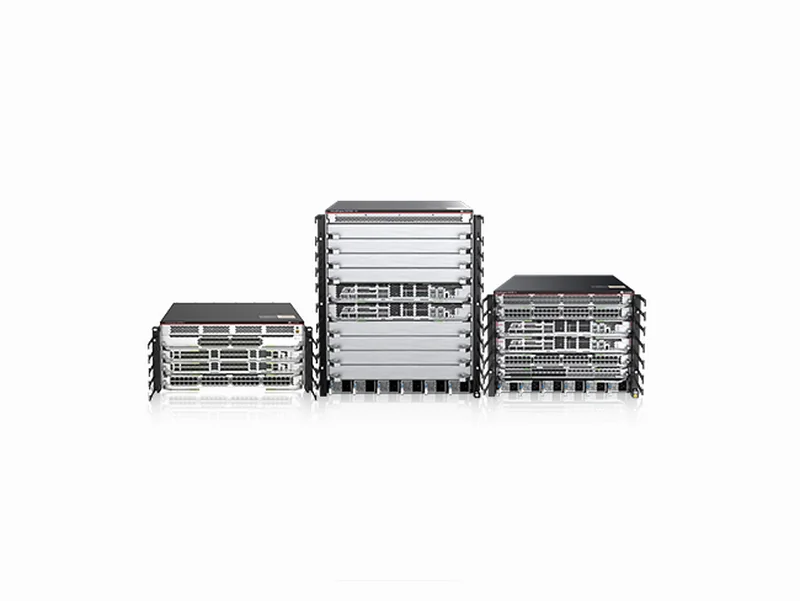
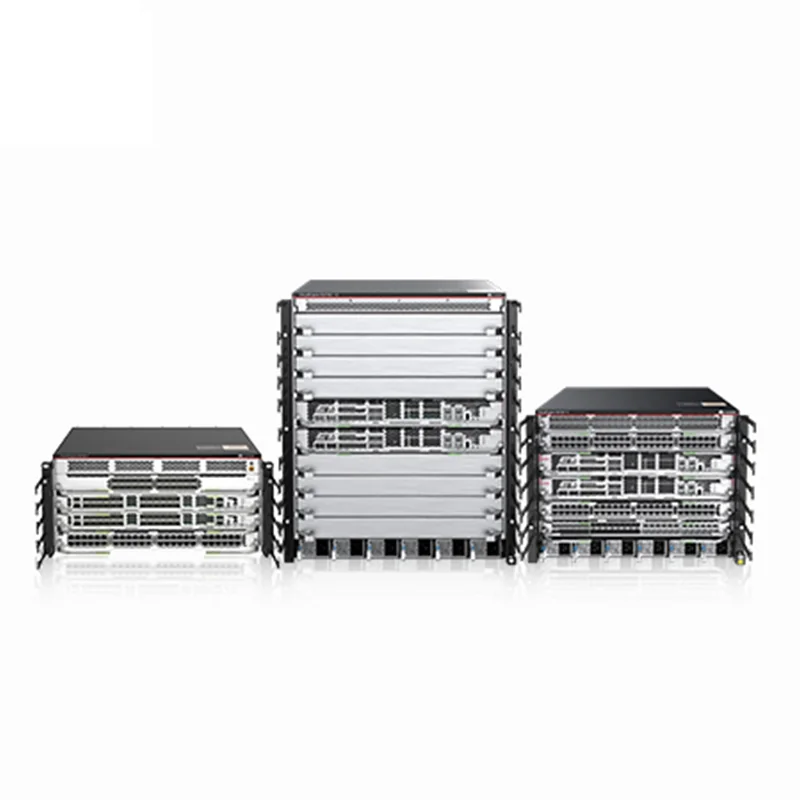
The Huawei CloudEngine S8700-10 is the top-of-range flagship modular campus core switch for premium campus networks in the Wi-Fi 6/7 […]

The Huawei CloudEngine S8700-10 is the top-of-range flagship modular campus core switch for premium campus networks in the Wi-Fi 6/7 era, offering up to 504 x 10GE or 134 x 100GE ports per chassis, active-active redundant main control boards with sub-5 ms failover and carrier-grade reliability for large campus networks.
Supports exclusive 72-port 10GE SFP+ line cards with 1.5x industry port density; up to 504 x 10GE, 400 x 25GE or 134 x 100GE ports per chassis.
Switching capacity of 170.6 / 768 Tbps and 128,000 Mpps forwarding rate; CLOS switching architecture on Huawei’s next-generation converged software platform.
Active-active dual main control boards with fast failover under 5 ms; redundancy design for main control, power and fan modules; support for SRv6 on X-series main control boards.
Innovative “Y + Psi (ψ)” front-to-rear air duct and mixed-flow fans deliver low power consumption, low noise and strong heat dissipation.
Supports VXLAN Layer 2/3 gateways, centralized/distributed gateway modes, BGP-EVPN and NETCONF; port-level MACsec for hop-by-hop encryption.
Telemetry and iPCA 2.0 in-service flow detection collaborate with iMaster NCE-CampusInsight for minute-level fault location; 6000+ application identification and experience assurance boards for deterministic audio/video quality.
A: 170.6 / 768 Tbps switching capacity with 128,000 Mpps forwarding rate and 10 service card slots.
A: Up to 504 x 10GE, 400 x 25GE, 262 x 40GE or 134 x 100GE ports per chassis depending on line cards.
Request a Configuration Review – Contact our sales team for chassis, line cards, experience assurance boards and bulk pricing.
| Component | Platform specifications |
|---|---|
| Product Model | CloudEngine S8700-10 |
| Form Factor | Modular campus switch, 13U, rack-mount |
| Chassis Height / Dimensions (W x D x H) | 13U / 442 x 515.5 x 575 mm |
| Weight (Empty / Full) | 39.84 kg / 97.35 kg |
| Switching Capacity | 170.6 / 768 Tbps |
| Forwarding Rate | 128,000 Mpps |
| Main Control Board Slots | 2 (1:1 hot standby, active-active detection, failover < 5 ms) |
| Service Card Slots | 10 (main control boards also provide service ports) |
| Switch Fabric Slots | 4 (2 integrated in main control, 2 independent fabric boards) |
| Fan Slots / System Power Supplies | 2 fan slots; 6 power supplies (N+0/N+1 redundancy, AC/DC/HVDC) |
| Max Port Density per Chassis | 480 x FE, 504 x GE, 504 x 10GE, 400 x 25GE, 262 x 40GE, 134 x 100GE |
| Experience Assurance | High-quality experience assurance board (R23C00) for Teams/Webex/Zoom/DingTalk/Huawei CloudMeeting/Tencent Meeting |
| VXLAN | Layer 2/3 gateways, centralized/distributed gateways, BGP-EVPN, NETCONF |
| Security | Port-level MACsec, NAC (MAC/802.1X authentication), policy association and free mobility |
| Smart O&M | Telemetry, iPCA 2.0, Netstream V5/V9, iMaster NCE-CampusInsight collaboration, OPS programmability |
| SRv6 | Supported with X-series main control boards |
Build the system around your workload, capacity and deployment requirements.
Choose from proven server, storage, GPU and networking platforms.
Validate compatibility and configuration details before you place an order.
One team supports specification, procurement and delivery coordination.
| Parameter | Specification |
|---|---|
| Brand | Huawei |
| Category | S8700 Series |
A configuration path focused on the capacity and performance you actually need.
Compare practical hardware choices without unnecessary complexity.
Align product selection with your rollout timeline and support requirements.
Keep room for future expansion as your infrastructure evolves.