01
Configuration-ready
Build the system around your workload, capacity and deployment requirements.

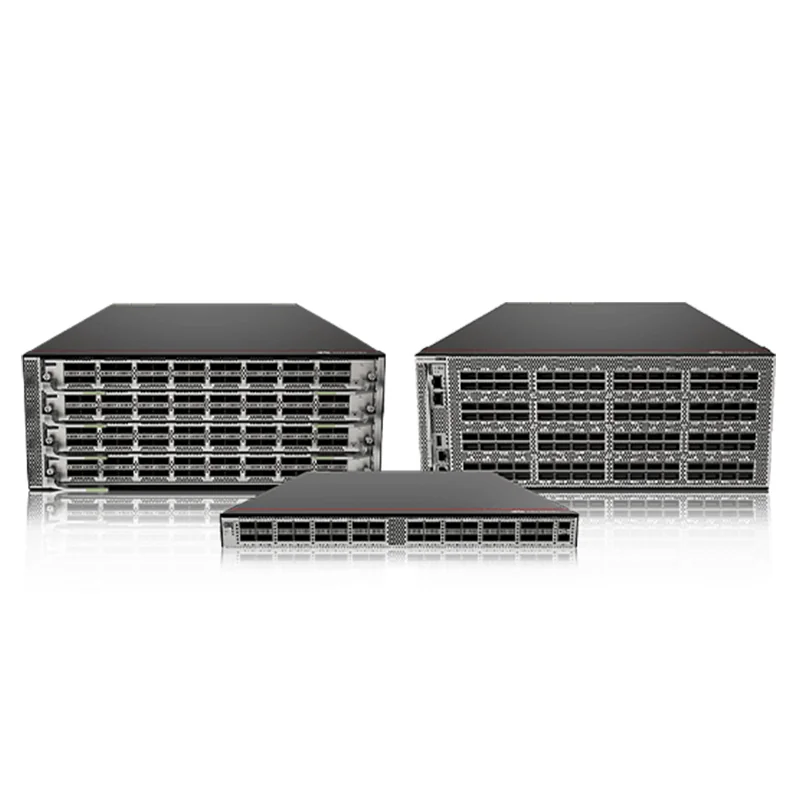
The Huawei CloudEngine 9865-4C is a new-generation high-density modular switch for data centers, supporting four full-width flexible cards with up […]

The Huawei CloudEngine 9865-4C is a new-generation high-density modular switch for data centers, supporting four full-width flexible cards with up to 128 x 100GE QSFP28 or 32 x 400GE QSFP-DD ports, delivering 25.6 Tbps switching capacity for core and aggregation deployments.
Supports four full-width flexible cards: CE98-D32CQ-F (32 x 100GE QSFP28, each port backward compatible with 40GE and splittable into 4 x 10GE/25GE) and CE98-D8DQ-F (8 x 400GE QSFP-DD, splittable into 4 x 100GE or 2 x 200GE).
Maximum configuration of 128 x 100GE or 32 x 400GE ports with 25.6 Tbps switching capacity and 19,200 Mpps forwarding rate.
Supports M-LAG cross-device link aggregation for device-level reliability with zero service interruption during upgrades, plus hardware-based BFD, DPFR, MoFRR and DPCF.
Acts as a high-performance VXLAN hardware gateway with BGP-EVPN control plane; supports 1588v2, MACsec, RoCE V1/V2, PFC and AI ECN, with Telemetry, Netstream, sFlow, ERSPAN+, IFIT and Packet Event for intelligent O&M.
A: Four full-width flexible card slots support CE98-D32CQ-F (32 x 100GE QSFP28) and CE98-D8DQ-F (8 x 400GE QSFP-DD) cards.
A: Up to 128 x 100GE QSFP28 or 32 x 400GE QSFP-DD ports, with 25.6 Tbps switching capacity and 19,200 Mpps forwarding rate.
Request a Configuration Review – Contact our sales team for card combinations, optical modules and bulk pricing.
| Component | Platform specifications |
|---|---|
| Product Model | CloudEngine 9865-4C |
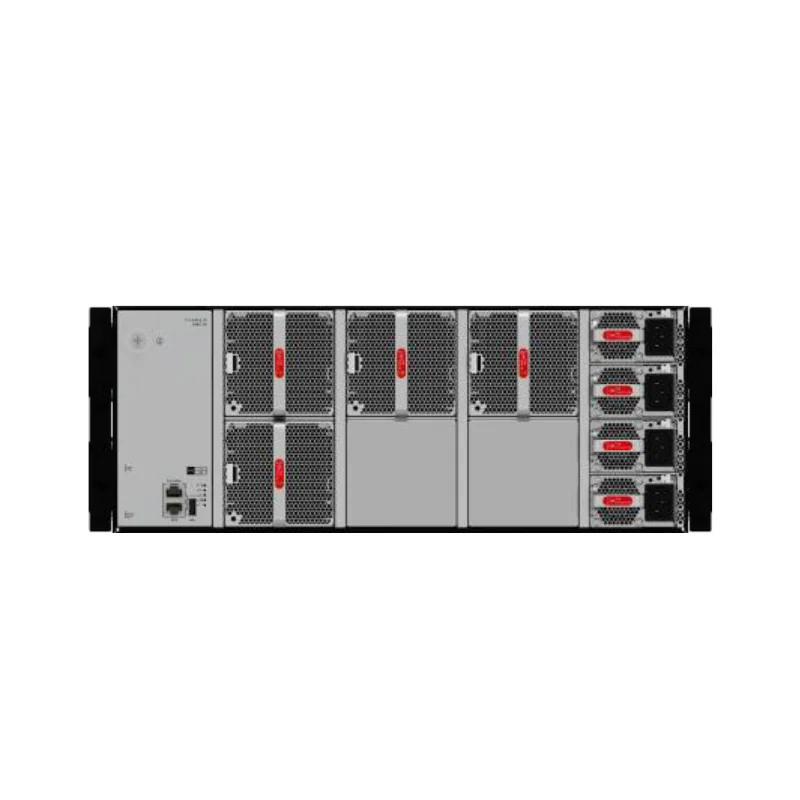
| Form Factor | Modular switch, 4U (4 full-width flexible card slots) |
| Card Options | CE98-D32CQ-F: 32 x 100GE QSFP28; CE98-D8DQ-F: 8 x 400GE QSFP-DD |
| Max Port Configuration | 128 x 100GE QSFP28 or 32 x 400GE QSFP-DD |
| Switching Capacity | 25.6 Tbps |
| Forwarding Rate | 19,200 Mpps |
| Buffer | 144 MB |
| Reliability | LACP, hardware-based BFD (3 ms), VRRP, M-LAG, DPFR, MoFRR, DPCF |
| Data Center Features | 1588v2, MACsec, RoCE V1/V2, VXLAN routing and bridging, BGP-EVPN, M-LAG, PFC, AI ECN, micro-segmentation |
| Smart O&M | Telemetry, Netstream, sFlow, SPAN/RSPAN/ERSPAN+, IFIT, Packet Event |
| Typical / Max Power | 1,465 W (4 x CE98-D32CQ-F cards) / 1,838 W (128-port 100G-SR4, full load) |
| Power Supply | 2000 W AC & 240 V DC; 2200 W DC; 2000 W HVDC (2+2 redundancy) |
| Operating Voltage | AC: 90 V to 290 V; DC: -38.4 V to -72 V; +38.4 V to +57 V; HVDC: 260 V to 400 V |
| Dimensions (W x D x H) | 442 mm x 756 mm x 175 mm |
| Weight (Fully Loaded) | 59.4 kg (with 4 PSUs and 4 fan trays); up to 70 kg with 4 x 32 x 100GE cards |
| Operating Temperature | 0°C to 40°C (0 m to 1,800 m) |
| Storage Temperature / Humidity | -40°C to +70°C; 5% RH to 95% RH (non-condensing) |



Build the system around your workload, capacity and deployment requirements.
Choose from proven server, storage, GPU and networking platforms.
Validate compatibility and configuration details before you place an order.
One team supports specification, procurement and delivery coordination.
| Parameter | Specification |
|---|---|
| Brand | Huawei |
| Category | CloudEngine 9800 |
A configuration path focused on the capacity and performance you actually need.
Compare practical hardware choices without unnecessary complexity.
Align product selection with your rollout timeline and support requirements.
Keep room for future expansion as your infrastructure evolves.